What's Actually Inside the Box: Data Centers, Noise, and Water in Real Numbers
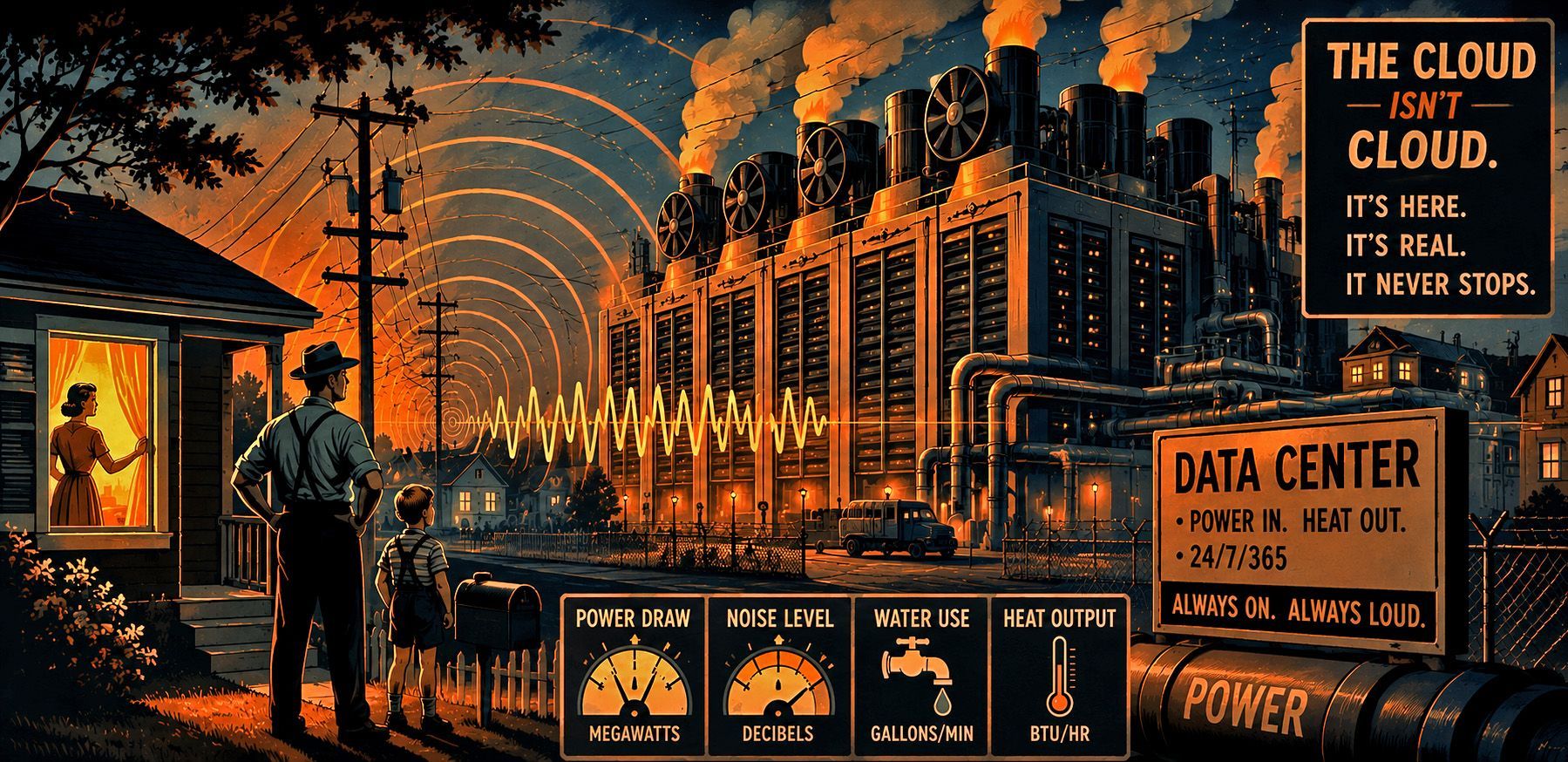
We call it the cloud. That word does a lot of work to make something physical sound like it isn't there.
A data center is not a cloud. It is an industrial facility. It pulls power off the grid at the same voltage levels used to run factories, it runs that power through transformers and generators the size of shipping containers, and it produces heat that has to be physically removed, twenty four hours a day, every day, for as long as the building stands.
What's actually documented about these facilities, the noise they generate, the water they consume, and the communities now suing over both, is not minimal. It is loud, in the most literal sense the word can carry.
This post breaks that down in parts. Each part carries its own graphic, built from sourced data, so you can see the numbers rather than just read about them.
What a Data Center Actually Is
Strip away the marketing language and a data center is a power conversion and heat removal plant with computers inside it. The servers are real, but they are a thin layer sitting on top of a much larger electrical and mechanical operation.
Power enters the site as medium voltage, typically in the range of 13.8 to 34.5 kilovolts, the same range used for industrial power distribution. That power is stepped down through transformers, run through uninterruptible power supply systems with battery banks, and backed by diesel or natural gas generators sized to carry the entire facility during an outage. From there it is distributed to racks of servers running at 480 or 415 volts. Every watt that goes in eventually becomes heat, and that heat is removed through massive air handling systems or liquid cooling loops, ultimately rejected to the outside air through cooling towers, chillers, or dry coolers.
Not all data centers are the same scale or purpose. Hyperscale facilities, the kind operated by Amazon, Google, Microsoft, and Meta, can run from tens to hundreds of megawatts on a single campus, with buildings reaching into the millions of square feet. Colocation facilities are owned by one company and rented out in pieces to many tenants. Enterprise data centers belong to a single organization, like a bank, running its own systems. Edge facilities are small and local, placed close to users for speed. Government and military data centers, like the NSA's facility in Utah, run at a scale and security level outside normal commercial classification.
The United States has roughly five thousand four hundred data centers, nearly half the global total, consuming over four percent of all electricity used in the country as of 2024. That consumption is projected to more than double by 2030. This is not a future consideration. It is the infrastructure layer underneath everything described in the first part of this series, the same 6G deployment, the same DoD investment, the same power grid carrying dirty electricity harmonics already documented.
The Sound Floor Problem
Here is the part that matters most for anyone living near one of these facilities. The danger is not that data centers are louder than everything else around you. A typical air conditioner condenser, the kind sitting outside most homes, runs around seventy to seventy five decibels at close range. A busy city street runs seventy to eighty five decibels. None of that alone explains why people are filing lawsuits.
What explains it is that the noise from a data center does not stop. It is continuous, twenty four hours a day, every day of the year. It is low frequency and tonal, a hum and a roar rather than a passing sound, which means it carries through walls and across distance in a way that traffic noise does not. And much of it happens at night, when the human body and most municipal noise ordinances expect quiet.
Federal and international guidelines draw clear lines here. The World Health Organization recommends night noise stay below forty decibels outside bedroom windows to protect sleep. The Environmental Protection Agency's long standing recommendation for outdoor residential noise is fifty five decibels, averaged across day and night with a penalty added for nighttime hours. Most local noise ordinances in the United States cluster around fifty five decibels during the day and forty five decibels at night, measured at the property line.
Now compare that to what is actually being measured and alleged near data center facilities. In Southaven, Mississippi, where Elon Musk's xAI operates a cluster of natural gas turbines powering its Colossus data center, residents filed a class action lawsuit in June 2026 alleging the turbine noise has at times exceeded seventy decibels, continuously, for twenty four hours a day. Resident measurements using sound level apps showed readings climbing from the forties indoors into the seventies outdoors. The Southaven mayor has stated recent readings run in the fifty decibel range, which by his own account is still pushing against what he asked the company to maintain.
This is not isolated to Memphis. In Loudoun County, Virginia, home to the densest cluster of data centers in the world, the county's own noise ordinance caps industrial noise at fifty five decibels at residential property lines, and residents have measured readings between seventy and eighty decibels near at least one facility. In Chandler, Arizona, residents near a data center described the sound as a blender running constantly, and one resident testified she had not had a full night's sleep in over two years. In Arkansas, residents near a cryptocurrency mining data center logged readings as high as ninety decibels, a dispute that led at least fifty of the state's seventy five counties to pass new noise ordinances in response.
The graphic below puts this on a single scale. Look at where the legal threshold sits, and look at where the documented and alleged data center readings land relative to it.
The Water Problem
Cooling a data center at scale requires water, often a great deal of it, and the geography of where that water comes from is now the subject of active lawsuits in multiple states.
In Coweta County, Georgia, residents filed suit in May 2026 to void the rezoning of an eight hundred twenty nine acre site for a seventeen billion dollar data center campus, citing the site's location inside a state designated significant groundwater recharge area. In neighboring Fayette County, Georgia, county utility officials discovered a data center operator had drawn more than twenty nine million gallons of water through a connection that was either unauthorized or unbilled, during a period when residents were under formal drought restrictions and reporting falling water pressure in their own homes. In Morgan County, Georgia, residents living near a Meta data center reported brown, sediment filled tap water, a situation serious enough that a sitting member of Congress held up jars of that water during a federal hearing and the EPA committed, on the record, to look into it.
In Virginia, an independent news outlet sued the Western Virginia Water Authority to force release of a water contract the authority had withheld as proprietary. A judge ruled in November 2025 that water use information is not proprietary and ordered it released, revealing the facility was contracted to receive up to eight million gallons of water per day at full build out. In Texas, Hill County's commissioners voted to impose a one year moratorium on new data center construction specifically citing water concerns, and the developer of a planned one thousand two hundred thirty five megawatt facility sued the county for more than one hundred million dollars over that decision. In Arizona, Tucson's city council unanimously rejected annexation and water service for a proposed data center campus after sustained community opposition, and the city later revoked a construction water permit after a contractor used water outside its approved service area.
These are not scattered anecdotes. They are filed lawsuits, county commission votes, judicial rulings, and congressional hearing testimony, across at least six states, within the same eighteen month period.
Texas and San Antonio
Texas is not a bystander in this. It is one of the fastest growing data center markets in the country, and San Antonio is part of that growth.
The Electric Reliability Council of Texas, ERCOT, tracked roughly two hundred twenty six gigawatts of large load interconnection requests as of late 2025, up from sixty three gigawatts just a year earlier, with the large majority of that growth coming from data centers seeking to connect by 2030. Statewide, Texas data centers are estimated to use over nine thousand megawatts of power and roughly twenty five billion gallons of water when accounting for both direct and indirect use through power generation.
Locally, far western Bexar County already has roughly two dozen operating data centers consuming around three hundred twenty four megawatts, with projections showing that figure could grow past three thousand megawatts by 2033. CPS Energy, the city owned utility, has committed to spending roughly one point three billion dollars on transmission infrastructure over the next five years specifically to serve this growth. Microsoft has operated in the region since 2005 and is currently expanding with projects exceeding four hundred million dollars. Tract Capital has announced campuses totaling over five thousand megawatts across more than three thousand five hundred acres in the surrounding counties. CloudBurst received approval for a fourteen point five billion dollar, one point two gigawatt campus near San Marcos, an approval that passed by a single vote amid organized community opposition over water and noise.
San Antonio City Council began formal consideration of data center specific policy in November 2025. That process is still open. What happens in it will determine whether the documented patterns in Georgia, Virginia, Arizona, and Texas's own Hill County repeat here, or whether the city writes rules ahead of the growth rather than after it.
What You Can Do
Start local. Your municipal noise ordinance is a public document, typically available through your city or county clerk's office, and it will tell you the legal decibel limit for your zoning classification, day and night. A sound level meter app on a phone is not a certified instrument, but it is enough to tell you whether a sustained reading near a facility is in a range worth raising at a public meeting.
Water utility contracts and consumption data are public record in most jurisdictions, though as the Virginia case shows, you may need to formally request them. CPS Energy and the San Antonio Water System both hold public board meetings with public comment periods. ERCOT's interconnection queue, the list of large projects seeking to connect to the grid, is published and searchable.
The pattern across every state covered in this post is the same. Organized residents who showed up to public meetings, filed formal records requests, and in some cases went to court, changed outcomes. Tucson's city council rejected a project after sustained public pressure. A Virginia judge forced disclosure of a water contract that would have otherwise stayed hidden. None of that happened by accident, and none of it happened without people first establishing the facts. Another blog will be written more specifically on actions AND MORE.
The danger here was never about a single number on a meter.
It is about what continuous, twenty four hour, low frequency noise and large scale water withdrawal do to a community over years, not days, and about the fact that the people approving these projects are very often not the people who will live next to them.
What is documented is not minimal.
It is loud.
It has plaintiffs, court filings, congressional testimony, and a federal docket.
The rest of this story, San Antonio's specific path, is still being written, and the public comment period is still open.
Stay informed. Stay Woke.
Sources
- IEA, via Pew Research Center. US data center electricity consumption, 183 TWh in 2024, approximately 4.4 percent of national electricity. October 2025.
- Cloudscene, 2025 data center count, United States.
- IEEE Spectrum. Data center power distribution architecture, medium voltage to low voltage conversion chain.
- Portillo, Fernandez-Ros, Novas, Garcia, Viciana, Gazquez. "Monitoring Harmonic ELF Magnetic Fields in Data Centers with Sensor-Based Instrumentation." IEEE Transactions on Instrumentation and Measurement. 2026.
- World Health Organization. Night Noise Guidelines for Europe. 2009.
- US Environmental Protection Agency. "Information on Levels of Environmental Noise Requisite to Protect Public Health and Welfare." 1974.
- Occupational Safety and Health Administration. 29 CFR 1910.95, permissible noise exposure limits.
- DeSoto Times. "Residents file class action lawsuit against xAI over noise." June 2026.
- Memphis Flyer. "Lawsuit Targets Continuous 'Squealing,' 'Roaring' from xAI's Southaven Center." 2026.
- WUSA9. Loudoun County data center noise ordinance and resident measurements reporting.
- Loudoun Now. "Sterling Residents Raise Alarms Over Off-Grid Data Center."
- Arizona Mirror and ABC15. Chandler, Arizona data center noise resident reporting.
- UALR Public Radio and CBS News. Arkansas data center noise ordinance reporting.
- Coweta County Superior Court filing, residents v. Coweta County and Atlas Development. May 2026.
- Fayette County, Georgia Water System. Director Vanessa Tigert correspondence regarding unbilled water use. May 2025.
- CBS News. Rep. Alexandria Ocasio-Cortez House Energy and Commerce Committee testimony regarding Morgan County, Georgia water quality. May 2026.
- Roanoke Rambler v. Western Virginia Water Authority, Roanoke Circuit Court ruling. November 2025.
- RCM Hill LLC v. Hill County, Texas, US District Court for the Western District of Texas, filed May 2026.
- Al Jazeera. Tucson, Arizona "Project Blue" reporting and city council annexation rejection. 2025 to 2026.
- ERCOT. Large load interconnection queue data, 2025 to 2026.
- Houston Advanced Research Center. Texas data center power and water use whitepaper. 2026.
- San Antonio Report. Bexar County data center capacity and growth projections, citing GridCARE analysis.
- CPS Energy. Public transmission investment statements.
- Courthouse News Service. "Texas lawmakers take up data center water use concerns."